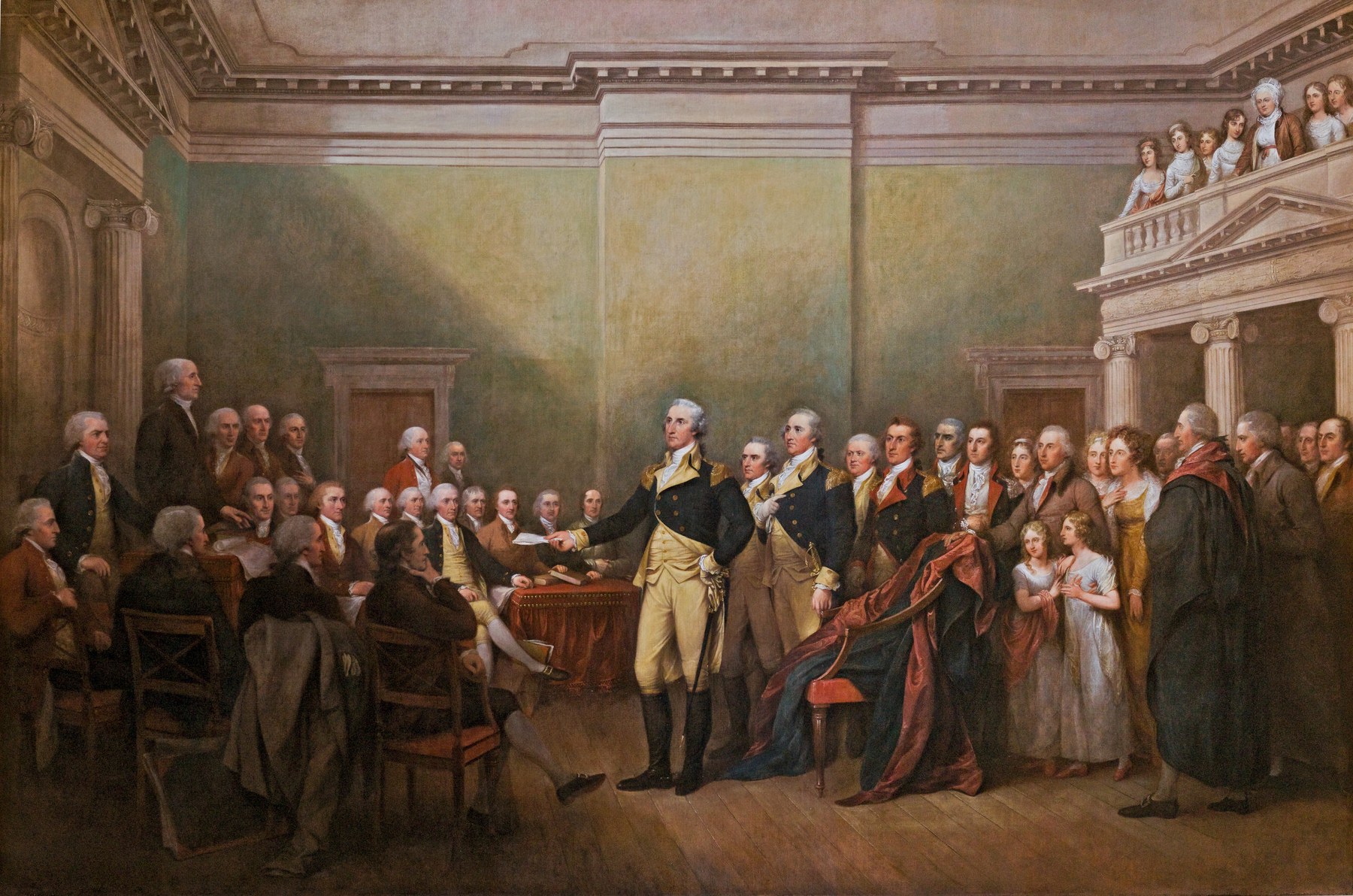
On December 23, 1783, George Washington appeared before Congress in Annapolis to surrender his military commission. In his resignation address, he described the authority he was returning as the “trust committed to me.” That phrase supplies a useful starting point for understanding the occasion: command was an assignment received from the country, carrying obligations to the body that had entrusted it to him. The Maryland State Archives preserves the address and accounts of the ceremony.
The civic significance lies in the relationship between achievement and authority. Success in a public assignment can make an officeholder admired, influential, even indispensable in the eyes of supporters. A republic must still be able to distinguish the person’s achievements from the continuing right to exercise power. Washington’s resignation gave that distinction a visible form. He returned the commission to Congress and asked to resume private life.
A public act of deference
The ceremony had a carefully prescribed order. A congressional committee specified how Washington would enter, where he would sit, when he would speak, and how Congress would receive his departure. He was to deliver both his commission and a copy of his address to the president of Congress. When Washington bowed, members were to acknowledge him by uncovering their heads without bowing in return. These arrangements appear in the historical notes accompanying the Archives’ transcription.
Such details can seem remote from the practical work of government. Yet protocol makes relationships legible. The general received the respect due to his service while recognizing the authority of the assembled representatives. Honor and accountability could occupy the same room. The forms gave spectators a way to see who possessed the commission, who had conferred it, and to whom it was being returned.
An eyewitness account by James Tilton, written to Gunning Bedford on Christmas Day and reproduced with the address, describes the crowded audience. Tilton reported that Washington delivered his speech, drew the commission from his clothing, and handed it to the president. After the formal proceedings, Washington returned to say farewell to the members before departing. Tilton’s account supplies a witness’s description of a public transaction, with the document itself passing from one set of hands to another. Read Tilton’s account.
Gratitude within an orderly government
The address also remembered the people who had helped carry out the command. Washington thanked his countrymen, acknowledged the army, and singled out the officers who had served closely with him. He recommended those still in service to Congress’s favorable attention. He closed with a prayer for the country and those responsible for its government, then took leave of the body “under whose orders I have so long acted.” Those acknowledgments are part of the complete resignation address.
There is a disciplined understanding of gratitude here. Service deserves recognition; the obligations owed to those who served belong before the institutions responsible for public decisions. Washington’s recommendation directed Congress’s attention toward his officers. It left Congress to act. The language joins personal loyalty to respect for an authority beyond the commander himself.
That combination remains useful in thinking about public responsibility. Institutions need the talents and commitment of particular people. They also need procedures that continue when those people leave. Admiration becomes more durable when it supports a lawful office and the duties attached to it. Citizens can honor a record of service while expecting an orderly conclusion to the assignment.
The responsibility to leave well
The lesson to draw from this episode concerns habits as much as rules. An officeholder can prepare successors, account for unfinished business, acknowledge colleagues, and accept that a commission has limits. Citizens have a corresponding task: to recognize restraint as a form of public service. An orderly departure should carry its own claim to respect.
A single ceremony cannot explain every strength or weakness of a political system. It can, however, make a governing principle concrete. Washington’s words and actions at Annapolis showed command being treated as a responsibility that could be completed and surrendered. For readers interested in conserving republican government, that is a demanding inheritance. It asks us to value the institution that survives the officeholder and the self-command required to return an entrusted power.